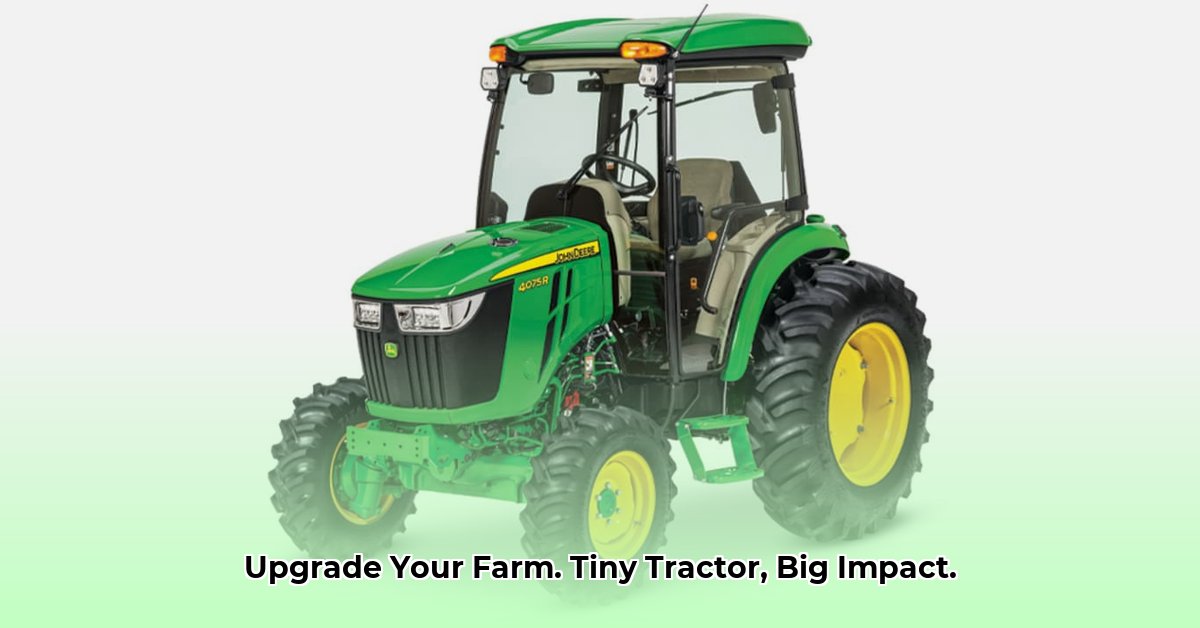
Choosing the right compact tractor can significantly impact your farm's efficiency and sustainability. This guide compares two popular models—the Yanmar YT235C and the John Deere 3 Series—to help you make an informed decision. We'll explore their features, performance, and suitability for various sustainable farming practices. Are you ready to optimize your farm operations? For more information on tractor costs, check out this helpful resource on tractor lease costs.
Yanmar YT235C: Maneuverability and Precision for Smaller Farms
The Yanmar YT235C is designed for precision and agility. Its compact size makes it ideal for navigating tight spaces in orchards, vineyards, and other small-scale farming operations. But is its smaller size a trade-off for power? Let's examine the details.
Pros:
- Exceptional maneuverability: Perfect for navigating tight spaces common in sustainable farming practices. It's agility is unmatched in its class.
- Compact size: Ideal for smaller farms and minimizes soil compaction, contributing to soil health.
- Reliable performance: Yanmar tractors are known for their robust build and dependable operation.
Cons:
- Lower lifting capacity compared to larger tractors: This might limit its suitability for certain heavy-duty tasks.
- Higher price per horsepower: You pay a premium for its specialized design and agility.
- Limited suitability for large-scale operations: Its size makes it unsuitable for wide-open fields.
John Deere 3 Series: Versatile Power for Diverse Applications
The John Deere 3 Series offers a balance of power and maneuverability. While not as nimble as the Yanmar in extremely confined spaces, it provides more power for a broader range of tasks. Its versatility makes it a strong contender, but is the extra power worth the cost and decreased agility?
Pros:
- Greater versatility: Handles a wider range of tasks compared to the Yanmar, from tillage to haying.
- Stronger lifting capacity: Capable of handling heavier implements and larger loads.
- Extensive dealer network: Simplifies maintenance and parts sourcing.
Cons:
- Reduced maneuverability in tight spaces: Not as agile as the Yanmar, which can be a drawback on smaller farms.
- Higher initial purchase price: Reflects its increased power and versatility.
- Some features may be unnecessary for simple, less intensive practices. You'll pay for features you might never use!
Yanmar YT235C vs. John Deere 3 Series: A Comparative Analysis
Choosing between these tractors depends on your specific needs. Let's compare their key features:
| Feature | Yanmar YT235C | John Deere 3 Series |
|---|---|---|
| Maneuverability | Excellent | Good |
| Power | Sufficient for smaller-scale farming | More powerful for diverse applications |
| Versatility | Specialized for smaller operations | More versatile for broader applications |
| Price | Generally lower initial investment | Typically higher initial investment |
| Fuel Efficiency | Good | Good to Excellent |
Note: Specific specifications vary by model. Always check individual product details before purchasing.
Your Personalized Smallest Cab Tractor Buying Guide: A Step-by-Step Approach
- Assess Your Needs: What tasks will the tractor primarily perform? Orchard work? Vineyard maintenance? Hay baling? This will heavily influence your choice.
- Set a Realistic Budget: Consider the initial purchase price, fuel costs, and potential maintenance expenses. Explore financing options.
- Analyze Specifications: Carefully examine horsepower, PTO power, lift capacity, and fuel efficiency.
- Arrange a Test Drive (if possible): Experience each tractor's maneuverability and responsiveness firsthand. This is crucial to making an informed decision.
- Consider Future Needs: Will your farm's operations expand in the future? Choose a tractor that can adapt to your future needs.
Sustainable Farming Considerations: Choosing the Right Tractor for a Greener Future
Both tractors can contribute to sustainable farming practices. The Yanmar's compact size minimizes soil compaction, a key aspect of soil health. The John Deere 3 Series's fuel efficiency can translate into lower operating costs and a reduced environmental footprint. Ultimately, the 'best' choice depends on the specific balance between performance, cost, and environmental impact that best suits your farm.
Choosing the right compact tractor is a significant investment. By carefully considering your farming operations, budget, and long-term goals, you can select the perfect machine to boost your farm's efficiency and sustainability.